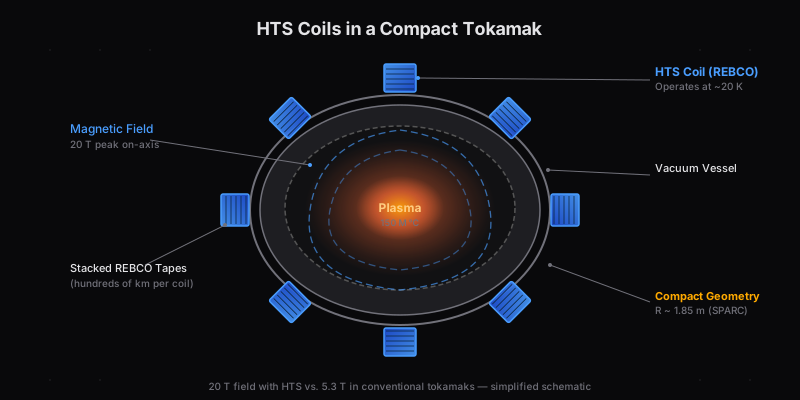
High-temperature superconducting (HTS) magnets are the single most important enabling technology behind the current wave of private compact-fusion companies. By allowing tokamak coils to reach sustained magnetic fields above 20 tesla — roughly double what the niobium-tin magnets in ITER can deliver — HTS lets designers shrink a fusion reactor by a factor of two in linear dimensions and more than an order of magnitude in volume while keeping the same fusion performance. That is the entire reason machines like SPARC and ARC exist as credible engineering proposals rather than paper studies.
We have covered the ten unsolved problems in nuclear fusion in a companion article; HTS magnets are one of them, but a slightly unusual one — the core physics works today at reactor-relevant scale, and the remaining questions are about engineering, manufacturing, and reliability. This piece explains why these magnets matter so much, what the REBCO tape they are built from actually is, and where the open problems still live.
What Makes a Fusion Magnet "High-Temperature"
In superconductivity, "high temperature" is a term of art. The workhorse superconductor of every large fusion experiment before 2020 — including ITER and JT-60SA — is niobium-tin (Nb3Sn), a low-temperature superconductor (LTS) that must be cooled below roughly 18 K to become superconducting and is typically operated near 4 K with supercritical helium. General Atomics' ITER central solenoid modules, which contain about 6,000 meters of Nb3Sn cable-in-conduit conductor each, run at 4.5 K and reach a peak field of 13 tesla.
REBCO — short for rare-earth barium copper oxide, most commonly yttrium barium copper oxide (YBCO) — is a ceramic that becomes superconducting below about 93 K, well above the boiling point of liquid nitrogen (77 K). Fusion magnets do not actually operate at 77 K, because the critical current density at that temperature is too low under strong fields. They operate around 20 K, cooled with supercritical helium or cryocoolers. "High temperature" in fusion context therefore means 20 K instead of 4 K — a factor of five, which changes everything about the cryogenics and the thermal margin against quench.
The other thing HTS buys is upper critical field. Nb3Sn loses superconductivity above about 30 T at 0 K and considerably less at operating temperature. REBCO, by contrast, remains superconducting in fields beyond 45 T at 4.2 K and still carries useful current at 20 K and 20 T — which is what fusion reactor magnets actually need.
Why Field Strength Is the Game Changer
The single most important scaling law in compact fusion economics is that fusion power density scales as B^4, where B is the on-axis toroidal magnetic field. Double the field and you get roughly 16 times the fusion power per unit volume. Triple it and the ratio is 81. This is the scaling that Dennis Whyte, Martin Greenwald, Joe Minervini, and their MIT colleagues argued in their 2016 paper "Smaller & Sooner: Exploiting High Magnetic Fields from New Superconductors for a More Attractive Fusion Energy Development Path", published in the Journal of Fusion Energy.
The consequence is counterintuitive. For decades, the conventional wisdom in magnetic-confinement fusion was that you had to go bigger to go better. ITER's 6.2 m major radius was chosen partly because the niobium-tin magnets of the 1990s simply could not reach the fields a smaller device would have required. If you can instead build a magnet at 20 tesla, the machine scaling law lets you shrink the major radius by roughly a factor of two while keeping the same fusion gain. That smaller device is cheaper, faster to build, and easier to iterate.
Here is the comparison:
- ITER (Nb3Sn): major radius 6.2 m, on-axis field 5.3 T, central solenoid peak 13 T, first plasma now targeting the mid-2030s
- SPARC (REBCO): major radius 1.85 m, on-axis field 12.2 T, toroidal-field coil peak 20 T, first plasma targeted 2027
- ARC concept (REBCO): major radius 3.3 m, on-axis field 9.2 T, ~200-250 MW electrical output
SPARC is roughly one-tenth the plasma volume of ITER yet aims at a similar fusion gain. That is the B^4 law cashing out in concrete hardware.
The REBCO Breakthrough
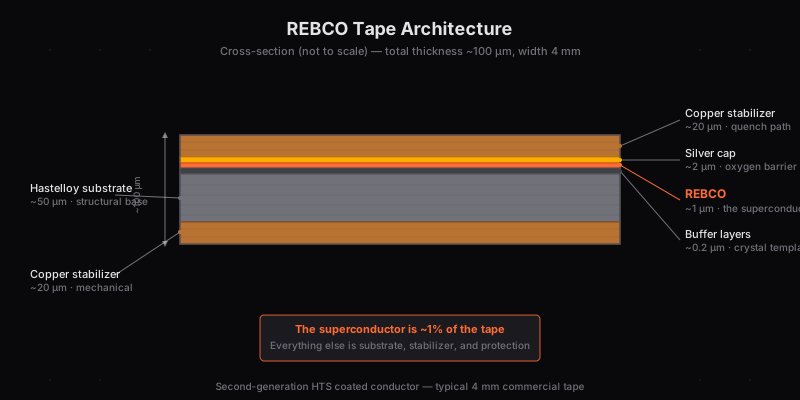
REBCO tape is not a bulk wire. It is a layered coated conductor, typically 4 mm wide and around 100 microns thick, in which the superconducting ceramic is deposited as a film about one micron thick on a textured metallic substrate. A single 4 mm tape at 20 K and 20 T can carry several hundred amperes of critical current; pioneering work by SuperPower, Fujikura, Faraday Factory, and others pushed commercial tape to kilometer-scale lengths in the 2010s.
The breakthrough that triggered the private-fusion boom happened on September 5, 2021, in a test cell at the MIT Plasma Science and Fusion Center. A full-scale toroidal-field model coil, designed and built jointly by Commonwealth Fusion Systems (CFS) and MIT, was ramped up and reached a sustained 20 tesla. The coil contained 267 kilometers of REBCO tape — roughly the distance from Boston to Albany — and consumed about 30 watts of electrical power once energized, several orders of magnitude less than a copper equivalent would require. Bob Mumgaard (CFS CEO), Zach Hartwig, and Dennis Whyte described the test as proof that the physics and engineering margins for SPARC were real.
The enabling cable architecture is called VIPER (Vacuum Pressure Impregnated, Insulated, Partially-transposed, Extruded, and Roll-formed), developed by Zach Hartwig's group at MIT. VIPER stacks REBCO tapes inside a copper jacket that doubles as a mechanical structure, a quench stabilizer, and an electrical joint. In March 2024, follow-up tests on the same magnet confirmed that its performance did not degrade across the full thermal and electromagnetic cycling a reactor would demand; the results were published across a package of papers in IEEE Transactions on Applied Superconductivity.
For comparison, ITER's central solenoid — built from Nb3Sn cable-in-conduit conductor, weighing about 1,000 tonnes and designed to operate at 4.5 K — reaches 13 T at its peak. The SPARC model coil reached 20 tesla at 20 K in a physically smaller package, with roughly 1/6000th of the operating cryogenic heat load. That is not an incremental improvement; it is a different operating regime.
SPARC and the Path to Commercial Fusion
Commonwealth Fusion Systems is building SPARC at its Devens, Massachusetts site. The 48-ton lower half of the vacuum vessel arrived on-site in October 2025; the cryostat base was installed earlier that year. In January 2026, CFS placed the first of 18 toroidal-field coils on its assembly jig. Assembly and commissioning are scheduled to continue through 2026, with first plasma targeted for 2027 and the Q > 1 net-energy milestone targeted shortly after. The follow-on machine, ARC, is the conceptual power plant described in the 2015 paper by Sorbom, Ball, Palmer, Whyte and colleagues in Fusion Engineering and Design — a 200-250 MW electrical tokamak with demountable HTS coils that allow modular replacement of the blanket.
CFS is not alone in betting on HTS. Tokamak Energy near Oxford ran its Demo4 HTS magnet set to 11.8 tesla at 20 K in November 2025, and its spherical tokamak ST40 reached one megaampere of plasma current in late 2025. Type One Energy, spun out of the University of Wisconsin-Madison, is pursuing a stellarator path with non-planar REBCO coils built on the VIPER concept, with plans to begin construction of its Infinity One test platform in 2026. Several national programs in Japan, China, and Europe have parallel HTS magnet-development efforts — the Institute of Plasma Physics of the Chinese Academy of Sciences tested an 80-kA HTS cable-in-conduit conductor at 10.85 T in 2025.
Open Engineering Challenges
If the physics is settled, what is still hard? A few things.
- Quench protection. When any spot in a superconducting coil loses superconductivity, the current keeps flowing but now encounters electrical resistance, dumping energy as heat. In low-temperature magnets, that normal zone spreads quickly and diagnostics can catch it in milliseconds. In REBCO, the normal zone propagates roughly two orders of magnitude more slowly, so hotspots can reach damaging temperatures before a voltage rise is even detected. Novel schemes using co-wound quench detectors, fiber-optic temperature sensing, and current-distribution monitoring are all active research topics.
- Mechanical stress. Lorentz forces scale as B² and become enormous at 20 T. A large HTS toroidal-field coil experiences hoop stresses measured in hundreds of megapascals, pressing the stack of tapes outward against its structural case. REBCO tape is mechanically delicate — the ceramic layer can delaminate from its substrate under tensile or shear load. Designing cables and coil cases that keep the tape in pure compression is one of the central engineering problems.
- Joint resistance. Reactor-class coils cannot realistically be wound as a single continuous tape. They must be joined, and joint resistance at cryogenic temperatures directly drives the refrigeration load. The VIPER cable's roll-formed copper jacket is in part an engineering answer to this problem.
- Manufacturing yield and cost. A SPARC-class tokamak needs hundreds of kilometers of REBCO tape meeting tight specifications on critical current, uniformity, and defect density. Global REBCO production capacity has grown substantially since 2021, but cost per kiloampere-meter is still well above what a commercial fleet would require, and manufacturing yield on long lengths remains a bottleneck.
- Long-pulse reliability. SPARC will run in pulsed operation. A power plant must run for years. Integrating HTS coils into a reactor that survives neutron irradiation of its cryostat and thermal cycling across thousands of disruptions is an open systems problem, closely connected to the broader challenge of long-duration plasma confinement.
Frequently Asked Questions
How does REBCO compare to the Nb3Sn used in ITER?
REBCO operates at roughly 20 K (versus 4 K for Nb3Sn) and sustains useful critical current in fields well above 20 T, whereas Nb3Sn magnets in practice top out near 13 T. The higher operating temperature also means a much larger thermal margin against quench and dramatically lower cryogenic power consumption.
Why do "compact" fusion reactors need stronger magnets?
Fusion power density scales as the fourth power of the magnetic field. If you double the field, you get about 16 times the fusion power in the same plasma volume, which means you can shrink the reactor for the same total output. Stronger magnets buy compactness directly.
Are HTS magnets already proven at reactor scale?
The 2021 SPARC toroidal-field model coil test demonstrated 20 tesla on a full-scale coil, and follow-up tests in 2024 confirmed that performance does not degrade under realistic cycling. Full reactor-scale integration — 18 coils acting together inside a tokamak that sees real plasma — is what SPARC itself aims to demonstrate in 2027.
Does HTS solve the fusion problem by itself?
No. HTS removes the "reactors must be enormous" constraint but leaves roughly nine other hard problems untouched, including first wall materials, tritium breeding, divertor thermal handling, and plasma disruptions. It is a necessary enabling technology, not a complete answer.
Can HTS magnets be used outside fusion?
Yes, and that is part of why costs are falling. REBCO is being deployed for compact MRI systems, particle accelerator magnets, grid-scale superconducting cables, and magnetohydrodynamic propulsion. The fusion market alone could not sustain REBCO manufacturing at the required scale; the cross-industry demand does.
Key Takeaways
- HTS magnets using REBCO tape can sustain magnetic fields above 20 tesla at 20 K, roughly 1.7 times the field of ITER's central solenoid, while consuming far less cryogenic power.
- The B^4 scaling law means doubling the magnetic field multiplies fusion power density by about 16, which is why higher fields enable dramatically more compact reactors.
- The September 2021 MIT-CFS toroidal-field model coil test demonstrated 20 tesla on a reactor-scale coil and is the empirical foundation of the current private-fusion wave.
- SPARC is under active assembly in Devens, Massachusetts, with first plasma targeted for 2027; Tokamak Energy, Type One Energy, and several national programs are pursuing parallel HTS paths.
- The remaining challenges for HTS fusion magnets are engineering — quench protection, mechanical stress under 20 T Lorentz forces, joint resistance, and REBCO manufacturing yield — rather than fundamental physics.
The Path Forward
High-temperature superconducting magnets did not arrive through a single eureka moment. They are the product of twenty years of incremental materials science, cable engineering, and tape manufacturing, most of it funded before any of the current fusion companies existed. What changed in 2021 was the proof that the performance could be delivered at reactor scale in an integrated magnet, not just in a short tape sample. That is why the private-fusion investment wave followed the model-coil test rather than preceding it.
The honest way to read the next few years is this: SPARC and Demo4 will tell us whether HTS magnets can be integrated into working tokamaks and survive real plasma operation. If they can, the path to a first-of-a-kind power plant becomes a question of solving the remaining nine roadblocks on a deadline. If the integration challenges bite harder than expected, the field will have learned something crucial about what still needs work.
At DeepScience, we track the latest fusion research through our AI-powered pipeline. Our Research Roadmap covers HTS magnets and the other open problems standing between today's experiments and commercial fusion power.