The evidence base for psychedelic-assisted therapy in 2026 is genuinely interesting and genuinely incomplete. Phase 2 and Phase 3 trials have produced statistically significant reductions in depression and PTSD symptoms that, at face value, compare favorably with standard antidepressants. At the same time, a 2024 FDA advisory committee vote against approving MDMA-assisted therapy for PTSD, persistent concerns about functional unblinding, and unresolved questions about durability and mechanism mean that the field is nowhere near the "revolutionary breakthrough" framing common in the popular press. What we have is promising Phase 2/3 data from small and methodologically contested trials, alongside real mechanistic progress in animal models that has yet to be cleanly linked to the clinical effects in humans.
What Psychedelic-Assisted Therapy Is
Psychedelic-assisted therapy is not a drug. It is a protocol that combines a single dose, or a small number of doses, of a classical psychedelic with structured psychotherapy delivered in a controlled clinical setting. In the trials that dominate the current evidence base, that protocol looks almost identical across sponsors: one to three preparatory sessions with a therapist dyad, one or two dosing sessions of six to eight hours during which the patient lies on a couch wearing eyeshades and headphones while the medication takes effect, and several integration sessions afterward to work through the experience.
The pharmacological agents studied include:
- Psilocybin, the active ingredient in psychoactive mushrooms, a serotonin 5-HT2A receptor agonist. The COMPASS Pathways COMP360 program is the most advanced.
- MDMA (3,4-methylenedioxymethamphetamine), a monoamine releaser that is not a classical psychedelic but is usually grouped with them in the clinical literature. Studied primarily for PTSD by the Multidisciplinary Association for Psychedelic Studies (MAPS), later spun out as Lykos Therapeutics.
- Ketamine and esketamine, which are NMDA receptor antagonists rather than 5-HT2A agonists, and which are the only drugs in this family with an FDA approval (Spravato, esketamine nasal spray, for treatment-resistant depression, approved in 2019).
- LSD, DMT, ayahuasca, and 5-MeO-DMT, all at earlier stages of clinical development.
Whenever this article says "psychedelic-assisted therapy," it refers to the drug-plus-therapy package, not to any drug alone. That distinction matters, because the trials do not answer the question of what would happen if you administered the drug without the surrounding therapy.
The Strongest Evidence So Far
Three datasets carry most of the weight in 2026. None of them is airtight, but all of them are serious.
COMPASS Pathways COMP001 (Phase 2b). Published as Goodwin et al. in the New England Journal of Medicine in November 2022, this trial randomized 233 patients with treatment-resistant depression to a single dose of 1 mg, 10 mg, or 25 mg of synthetic psilocybin alongside psychological support. The 25 mg arm showed a statistically significant reduction in MADRS (Montgomery-Åsberg Depression Rating Scale) scores at week 3 compared with the 1 mg active-comparator arm (p < 0.001). Approximately 37% of patients in the 25 mg arm were responders at three weeks, and 29% were in remission. The effect had substantially attenuated by week 12. Suicidal ideation and self-injurious behavior were reported in all three dose arms, including the low-dose comparator, which complicates safety interpretation.
COMPASS COMP005 (Phase 3). In 2025, COMPASS reported topline results from the first of two Phase 3 trials in treatment-resistant depression. A single 25 mg dose of COMP360 versus placebo produced a statistically significant MADRS reduction at week 6 (p < 0.001), with a placebo-adjusted difference of 3.6 points. That effect is modest in absolute terms — roughly in the same range as conventional antidepressants over the same window — and the 26-week durability data from the companion COMP006 trial are not expected until the second half of 2026. Investors reacted cautiously, and so should readers.
MAPS MAPP1 and MAPP2 (Phase 3 MDMA for PTSD). Mitchell et al., Nature Medicine 2021, reported MAPP1: 90 participants with severe PTSD, MDMA versus placebo with identical manualized therapy. The reduction in CAPS-5 scores was large in a statistical sense (Cohen's d = 0.91, p < 0.0001), and 67% of participants in the MDMA arm no longer met PTSD criteria at study end versus 32% in the placebo arm. The confirmatory MAPP2 trial, published in Nature Medicine in September 2023, enrolled 104 participants with moderate-to-severe PTSD and broadly replicated the effect: 71% of the MDMA-treated group no longer met PTSD criteria at 18 weeks.
On paper, these are extraordinary numbers for PTSD, a condition where existing first-line SSRIs produce remission in roughly a quarter of patients. That is why the MAPS New Drug Application was expected to sail through review in 2024.
It did not.
In June 2024, the FDA Psychopharmacologic Drugs Advisory Committee voted 2–9 against the effectiveness of MDMA-assisted therapy for PTSD, and 1–10 that the benefits outweighed the risks. The FDA issued a Complete Response Letter to Lykos Therapeutics in August 2024, declining approval. The committee's central concerns were functional unblinding (most patients correctly guessed whether they had received MDMA or placebo), expectancy effects, the inability to disentangle the drug's contribution from the therapy's contribution, questions about generalizability given a homogeneous participant pool, and reports of protocol deviations at some sites. None of these critiques is, strictly speaking, new. What changed is that a regulator applied them with teeth.
The Mechanism Debate
How psychedelics produce sustained clinical effects after a single dose is the most interesting and least settled question in the field. Three broad hypotheses compete, and they are not mutually exclusive.
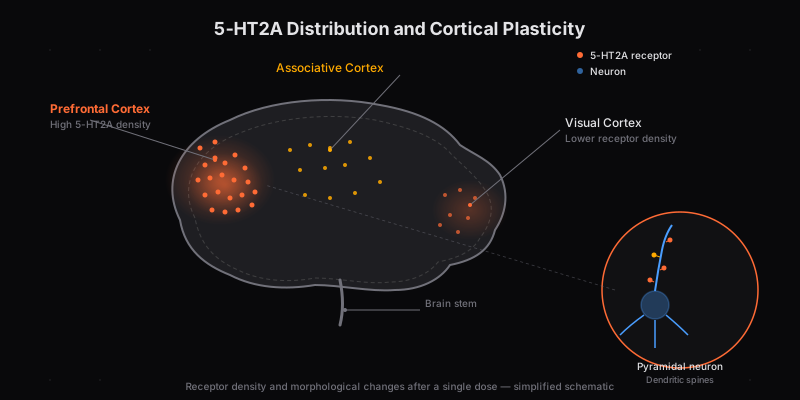
Classical 5-HT2A agonism. Psilocybin, LSD, and DMT are full or partial agonists at the serotonin 5-HT2A receptor, and pretreatment with the 5-HT2A antagonist ketanserin abolishes the subjective effects of psilocybin in humans. This is the most established mechanistic fact about classical psychedelics. What is less clear is how receptor activation lasting hours produces clinical effects lasting weeks.
The entropic brain hypothesis. Proposed by Robin Carhart-Harris (then at Imperial College London, now at UCSF) and Karl Friston in Frontiers in Human Neuroscience, 2014 and updated in the "entropic brain revisited" paper in 2018, the hypothesis argues that psychedelics increase the entropy of spontaneous brain activity, relaxing the grip of high-level priors encoded in the default mode network (DMN) and opening a transient window in which maladaptive patterns — such as ruminative self-focus in depression — can be revised. Carhart-Harris's own fMRI work with psilocybin showed reduced DMN integrity under the drug and subsequent normalization of depression-related hypoconnectivity in responders.
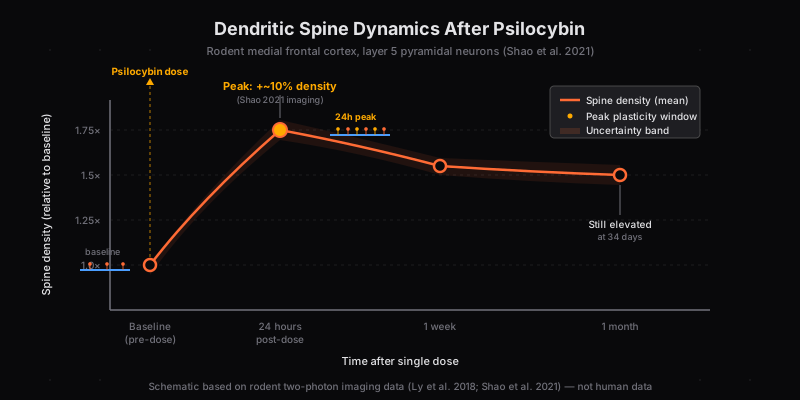
The psychoplastogen framework. Developed by David Olson (UC Davis), this framework reframes psychedelics as "psychoplastogens" — compounds that rapidly promote structural and functional neural plasticity. In the foundational paper, Ly et al., Cell Reports 2018, showed that LSD, DMT, and DOI promote dendritic branching and increase spine density in rodent cortical neurons. Shao et al., Neuron 2021, used chronic two-photon microscopy to show that a single dose of psilocybin in mice produced roughly a 10% increase in spine size and density in layer 5 pyramidal neurons of the medial frontal cortex within 24 hours, and that the new spines persisted at least a month. Olson's provocative claim is that the subjective experience might not be necessary — that the plasticity is the therapy, and compounds that induce plasticity without hallucinations ("non-hallucinogenic psychoplastogens") could in principle work just as well.
These are competing stories about what matters: the acute psychedelic experience (entropic brain view), the downstream structural remodeling (psychoplastogen view), or both. The question has immediate practical stakes, because if Olson is right, the entire therapeutic model built around preparation and integration sessions may be overbuilt relative to what the drug is actually doing. If Carhart-Harris is right, stripping out the experience would gut the treatment.
What 2024-2026 Research Has Clarified (and Hasn't)
The past two years have produced clarification around the edges and very little resolution at the center.
On the neuroimaging side, Daws et al., 2022 and subsequent work have reported that psilocybin increases global brain network integration in depressed patients and that the magnitude of this effect correlates with symptom improvement up to six weeks post-treatment. Baseline connectivity signatures in the default mode, visual, and executive networks appear to have some predictive value for response. These are effects, not mechanisms — they tell us something changes, not why the change produces durable relief.
On the animal side, the psychoplastogen story has continued to strengthen. Multiple labs have now replicated the dendritic spine findings with different classical psychedelics and different cortical regions, and engineered non-hallucinogenic analogs from Olson's lab have shown antidepressant-like effects in rodent assays without head-twitch responses. Whether those assays translate to humans is an open empirical question that will be answered, or not, by the next generation of trials.
On the clinical side, meta-analyses through 2024 and 2025 consistently find moderate-to-large effect sizes for psilocybin in depression, with pooled Hedges' g values in the 0.6 to 0.9 range, but also consistently flag low-to-moderate certainty of evidence under the GRADE framework, citing small sample sizes, short follow-ups, and the blinding problem. A 2024 systematic review in the BMJ reported a pooled effect of g = 0.66 (95% CI 0.46–0.86) for psilocybin on depression symptoms, with the caveat that effect sizes shrank substantially when the analysis adjusted for expectancy.
What has not been clarified: whether any of these interventions produce durable, cost-effective benefit beyond twelve months in unselected real-world populations. That question is unanswerable from the data we currently have.
Open Questions: Blinding, Durability, Equity
Three critiques deserve to be taken more seriously than they often are in the popular coverage.
Blinding is a structural problem, not a fixable one. In a randomized controlled trial of a drug that reliably produces vivid visual and interoceptive effects, the participant almost always knows whether they received the active arm. Muthukumaraswamy et al. (2021) reported blinding integrity assessments showing that in one trial, 90 of 95 treated patients correctly guessed their allocation. A standard two-arm placebo-controlled design cannot mask a subjective experience as intense as a full psychedelic dose. Various remedies have been proposed — active placebos like niacin or low-dose methylphenidate, dose-finding designs with multiple active arms, causal mediation analysis tying outcomes to biomarker-verified drug exposure — but none fully solves the underlying issue. Expectancy effects in psychedelic trials are almost certainly inflating reported efficacy, and the honest question is by how much.
Durability beyond 6 to 12 months is unclear. The trials that exist mostly report outcomes at 3, 6, and 12 weeks. Longer-term follow-ups exist but are typically open-label, with substantial attrition and obvious selection effects among the participants who agree to continue being tracked. Whether a single dose or two-dose protocol produces lasting remission, or whether it buys a few months of improvement that then fades, is a question the 2026 evidence base cannot answer cleanly.
Access, cost, and equity are real. Even if the clinical benefit turns out to be as advertised, psychedelic-assisted therapy as currently designed requires multiple hours of therapist time per session, delivered by trained therapist pairs, in a controlled setting, with extensive preparation and integration. Per-course cost estimates run from several thousand to over fifteen thousand US dollars. Scaling this to the tens of millions of patients with treatment-resistant depression or PTSD who could plausibly benefit is a logistical problem on the order of scaling dialysis. We have covered the science of treatment-resistant depression in a companion article, including the broader landscape of ketamine, TMS, and emerging biomarker-guided approaches.
Legal status is also worth naming clearly. As of 2026, psilocybin, MDMA, LSD, and DMT remain Schedule I controlled substances under US federal law, and most equivalent schedules in Europe and elsewhere. Ketamine and esketamine (Spravato) are the only drugs in the broader family with FDA-approved indications for depression. Oregon and Colorado have established state-level regulated psilocybin service programs outside the FDA framework, but these are not medical treatment in the conventional regulatory sense.
Frequently Asked Questions
Is psychedelic-assisted therapy FDA-approved in 2026?
Not for psilocybin, MDMA, or other classical psychedelics. Esketamine (Spravato) is FDA-approved for treatment-resistant depression and for depressive symptoms in adults with major depressive disorder with acute suicidal ideation, but it is an NMDA antagonist and is typically not grouped with classical psychedelics. The FDA issued a Complete Response Letter in August 2024 declining to approve MDMA-assisted therapy for PTSD. COMPASS Pathways' psilocybin program is in Phase 3 with the first trial's positive topline reported in 2025; an FDA submission has not yet occurred.
How does it compare to SSRIs?
Comparison is difficult because the trial populations and durations differ. In head-to-head data from the 2021 Carhart-Harris et al. NEJM trial, psilocybin was non-inferior to escitalopram on the primary endpoint but outperformed it on several secondary measures. Network meta-analyses through 2024 suggest pooled effect sizes for psilocybin in depression in the moderate-to-large range, though these estimates are likely inflated by expectancy effects and should be interpreted with caution. The claim that psychedelics are dramatically better than SSRIs is not supported by the current controlled evidence.
Is it safe?
In controlled clinical trials with rigorous screening, serious adverse events have been rare. Contraindications typically include personal or family history of psychotic disorders, uncontrolled cardiovascular conditions, and certain medications. Outside controlled settings, risks include acute anxiety and dysphoria, behavioral dysregulation, and — particularly for MDMA — cardiovascular stress and serotonergic drug interactions. The safety profile of supervised, screened clinical use should not be extrapolated to unsupervised recreational use.
What is the blinding problem, and why does it matter?
In a placebo-controlled trial, the ideal is that neither participants nor researchers know who received the active drug. With psychedelics, participants usually know immediately — the subjective effects are unmistakable. This means observed improvements may reflect not just the drug's pharmacology but also participants' expectations, and the effects researchers' assessments. The blinding problem does not mean the treatments don't work. It means we cannot tell from the current trials how much of the effect is pharmacological versus expectancy-driven.
Should I try psychedelic therapy?
This article takes no position on individual treatment decisions, which belong with a qualified clinician who knows your history. The purpose here is to describe the state of the evidence, not to recommend action.
Key Takeaways
- Phase 2 and Phase 3 trials show statistically significant effects for psilocybin in treatment-resistant depression and MDMA in PTSD, with effect sizes that are large on paper but likely inflated by expectancy effects and functional unblinding.
- The FDA rejected MDMA-assisted therapy in August 2024, and the reasons — unblinding, expectancy, site conduct, safety data gaps — apply in varying degrees to the psilocybin program as well.
- Three competing mechanistic hypotheses — 5-HT2A agonism, the entropic brain, and the psychoplastogen framework — make different predictions about whether the subjective experience is necessary for therapeutic benefit, and none has been definitively tested in humans.
- Durability beyond 6 to 12 months is not established for any psychedelic-assisted therapy protocol, and cost and access concerns are substantial even if efficacy holds up.
- Legal status matters: most classical psychedelics remain Schedule I in the US in 2026, and state-level regulated programs in Oregon and Colorado are distinct from FDA-approved medical treatment.
The Path Forward
Psychedelic-assisted therapy is a real, active area of clinical research with genuine signals and genuine unresolved problems. The most useful framing in 2026 is neither "miracle cure" nor "placebo in a trench coat." It is that we have moderately strong short-term data from methodologically contested trials, compelling mechanistic findings in animal models, and roughly a decade of hard work still required to answer the durability, mechanism, and access questions that will determine whether any of this reaches routine clinical practice at scale.
At DeepScience, we track mental health research through our AI-powered pipeline. Our Research Roadmap covers psychedelic mechanisms and the other open problems in psychiatric science, including treatment-resistant depression.